How to Run a Fun Run Counting Day
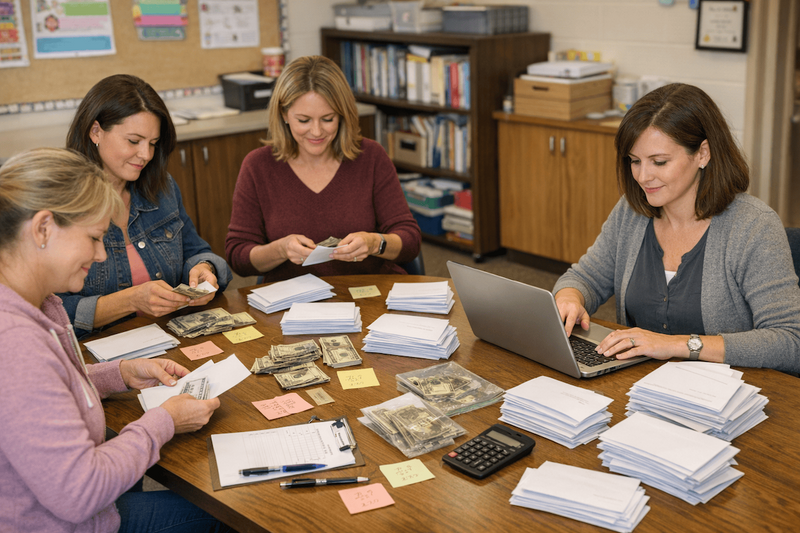
Strong rules around counting money protect your parent group. Count every class separately, double-count all money, never leave cash with one person, and have the treasurer reconcile totals before the deposit.
Start here
Counting days are one of the weakest points in many school fundraisers.
They often involve:
- envelopes full of cash
- multiple volunteers
- lots of opportunity for things to go awry
Unfortunately, fraud or embezzlement is one of the most common financial crimes affecting PTOs, PTGs, and PTAs.
The best protection is simple: build procedures where money is always visible and always verified.
These controls apply to fun runs, but they work for any school fundraiser involving cash.
The treasurer should oversee counting day
The treasurer should manage the counting process and reconcile the totals before money goes to the bank.
That does not mean the treasurer has to do every task. Volunteers can help count and organize envelopes.
But the treasurer should:
- oversee the counting process
- confirm totals
- enter the official numbers
- prepare the deposit
This creates a clear chain of responsibility.
How to set up the counting room
Ideally, your school can provide you a private room where you can count all the donations.
Clip each classroom’s envelopes together before counting begins.
If possible, set up three work areas:
Table 1 – Counting table Volunteers sit here and open envelopes.
Table 2 – Envelopes waiting to be counted Classes waiting their turn.
Table 3 – Completed classes waiting to be entered Money that has been counted and verified.
Keeping these stages separate helps prevent mistakes.
Teachers should send envelopes to the front office as soon as the school day begins. One student can collect the class envelopes and bring them to the office or counting room.
First Count
Never mix envelopes from different classrooms.
Each class should remain separate until the totals are verified and entered into the system.
For each envelope:
- Open the envelope and total the contents.
- Write the amount on the envelope.
- Initial and date the envelope.
- Repeat for every envelope in the class.
Once all envelopes for the class are counted:
- combine all cash, checks, and coins from that class
- place the money in a ziplock bag
- write the class name and total amount on a sticky note
- place the note inside the bag so the amount is visible
Then pass the bag to another volunteer for verification.
Second count
This must be done by a different volunteer.
A second volunteer removes the money from the bag and recounts it.
Confirm that the amount matches the total recorded by the first counter.
If the totals match, the envelopes move to the “ready to enter” table.
If they do not match, recount the class immediately. If they still don’t match, get a third counter involved.
Double counting protects everyone involved.
Enter donations into the system
At this point the treasurer should have:
- the envelopes with confirmed donation totals
- a ziplock bag containing the class’s cash, checks, and coins
- a sticky note showing the verified class total
The treasurer can now enter the donation for each student, based on the total on the envelope.
Once the entire class’s envelopes have been counted, the treasurer should confirm that the class’s donation total matches the amount provided in the ziplock bag.
Save the results and move on to the next classroom.
Prepare the bank deposit
After all classes are reconciled:
- Count cash totals
- Count check totals
- Count coins
Each stack should be double-counted by two people.
Prepare two deposit bags:
- one for cash and checks
- one for coins
Deliver the deposit to the bank
The treasurer usually takes the deposit to the bank.
If possible, send another volunteer with them.
This is not about distrust. It is about protecting everyone involved.
When financial procedures are visible and structured, it becomes extremely difficult for money to disappear.
Wrap-up
Once the counting is finished, you can shift back to the fun part of the fundraiser.
If you’re giving prizes to kids who bring in a donation, now’s the time to give those out.
If you have a large fundraising thermometer in your school, update it to reflect the new total.
If your parent-teacher group is giving classroom rewards, inform each class that has won something.
Reach out to any classroom that’s near the goal and encourage them to do a few more donations to get over the line.
Core counting day rules
Every counting day should follow four simple rules:
- Keep each classroom separate.
- Always double-count money.
- Never leave cash with one person.
- The treasurer verifies totals before deposit.
Counting day checklist
Before counting begins:
- Treasurer confirms deposit materials.
- Volunteers understand the counting process.
- Tables are organized by counting stage.
During counting:
- Keep each classroom separate.
- Record totals on envelopes.
- Double-count all money.
- Treasurer alone enters donations into the fundraising software.
After counting:
- Prepare the bank deposit.
- Hand out rewards.
- Update the thermometer.
- Reach out to any classrooms that are on the cusp of earning a reward.
Then continue to Event Day.